



Haridra
₹549
₹599
8% OffFinal Price inclusive of all taxes
Cash on Delivery
Free Delivery
Get it delivered in 4-9 days
size
100 Capsules
Product Information
Brand
Age Ayurveda
Ingredients
Turmeric (Curcumin)
Usage
Anti-Inflammatory And Skin Support
Product Type
Ayurvedic Herbal Supplement
Pack Of
1
Country of Origin
India
Product Description
DESCRIPTION
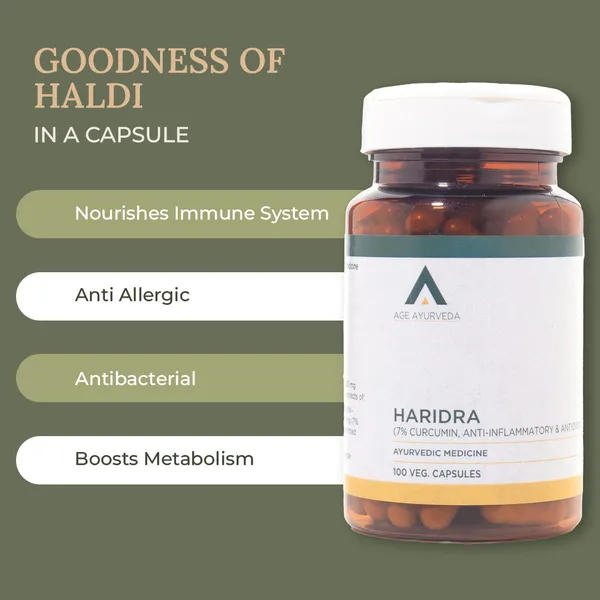
The Goodness of Haldi in a Capsule
Boosts Metabolism
Nourishes the Immune System
Antibacterial
Anti-Allergic
BENEFITS OR INGREDIENTS
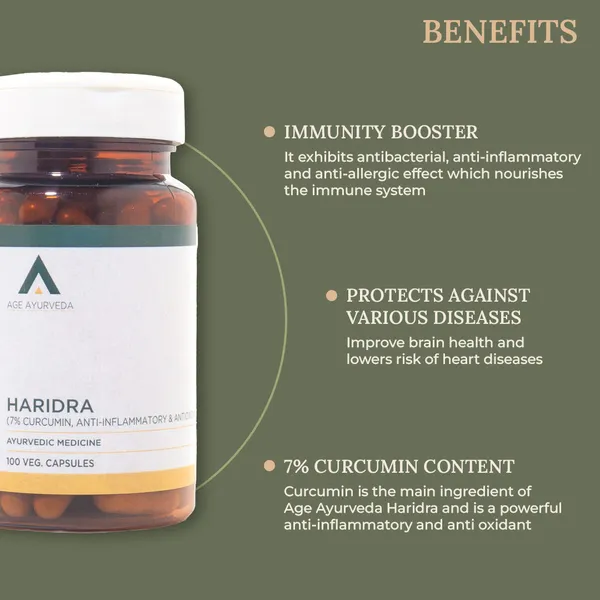
Immunity Booster to Exhibits antibacterial, anti-inflammatory, and anti-allergic effects that help nourish and strengthen the immune system.
7% Curcumin Content to Curcumin, the main ingredient in Age Ayurveda Haridra, is a powerful anti-inflammatory and antioxidant compound.
Protects Against Various Diseases to Supports brain health and helps lower the risk of heart diseases.
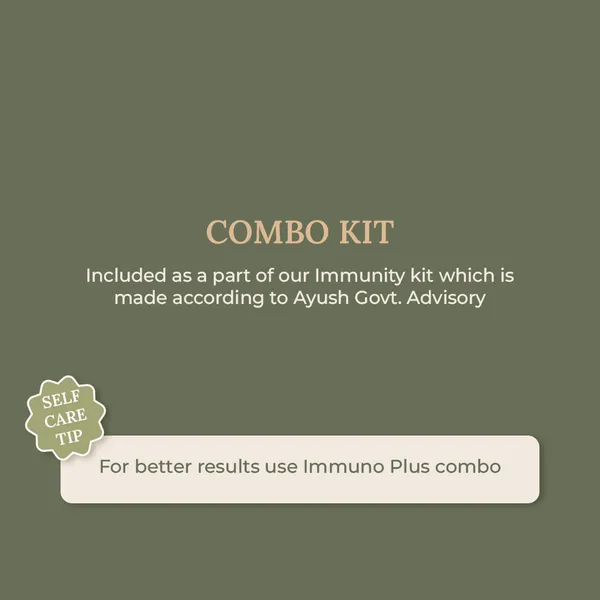
Combo Kit to Part of our Immunity Kit, crafted in accordance with the Ayush Government Advisory.
SELF-CARE TIP: For best results, use the Immuno Plus Combo.
FORMULATION & INSTRUCTIONS
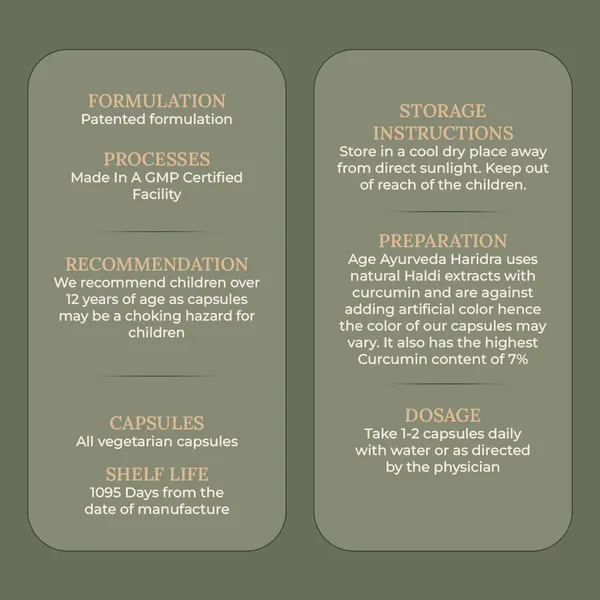
Preparation: Age Ayurveda Haridra is made from natural Haldi extracts with curcumin, without any artificial colors. As a result, capsule color may vary. It contains the highest Curcumin content at 7%.
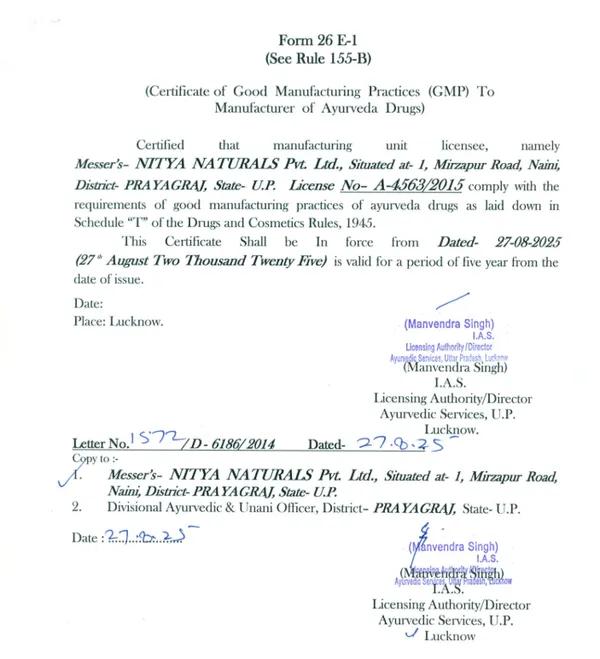
PROCESSES: Manufactured in a GMP-certified facility.
FORMULATION: Patented formulation for enhanced effectiveness.
CAPSULES: 100% vegetarian capsules.
DOSAGE: Take 1 to 2 capsules daily with water, or as directed by a physician.
RECOMMENDATION: Suitable for individuals aged 12 years and above. Capsules may pose a choking hazard for younger children.
SHELF LIFE: 1095 days from the date of manufacture.
STORAGE INSTRUCTIONS: Store in a cool, dry place away from direct sunlight. Keep out of reach of children.
MORE DETAILS
What is Haldi?
Turmeric or popularly known as Haldi in India, whose botanical name is Curcuma longa, and it belongs to the ginger family. The plant reaches barely three feet in height and produces both a flower and a rhizome, also known as modified stem that is found underground, and it has oblong leaves. It's found and cultivated in tropical climates across Asia, primarily for its rhizome.
This perennial, herbaceous, and rhizomatous plant is native to India and South-East Asia.
How and where is Haldi Cultivated?
Haldi (Turmeric) is a Kharif crop which grows well in hot and humid climate. The plant needs temperatures between 20 Degree C and 30 Degree C and a considerable amount of annual rainfall to thrive. Cultivation of Turmeric is done by sowing of the root stalk, during spring season, which makes the plant ready to harvest within 7 to 8 months.
India produces nearly all of the world's turmeric crop and consumes 80% of it. The Indian turmeric, with its high content of the bioactive compound (curcumin), is considered to be the best in the world. The various varieties grown include Alleppey Finger, Erode Turmeric, Salem Turmeric, Rajapore Turmeric, Nizamabad Bulb, and more.
What are the medicinal uses of Haldi?
Turmeric is a plant that has a very long history of medicinal use, dating back nearly 4000 years in India. Ayurvedic medical treatises and authoritative books have documented these uses.
The famous Sage Maharishi Sushruta, in his compilation of Ayurvedic text, dating back to 250 BC, has mentioned the use of turmeric with its antiseptic properties by recommending an ointment containing turmeric to relieve the effects of poisoned food.
Ayurvedic texts and authoritative books mention its usages in treatment for various respiratory conditions, e.g., asthma, bronchial hyperactivity, and allergy, as well as liver disorders, anorexia, rheumatism, diabetic wounds, runny nose, cough, and sinusitis. Turmeric has also been used to treat sprains and swelling. It is considered a digestive herb and a herb to reduce flatulence. Ayurvedic practitioners use turmeric to expel phlegm (Kapha) as well as to open blood vessels in order to improve blood circulation.
In Ayurvedic practices, one of the properties includes strengthening the energy of the body, dispelling worms, improving digestion, regulating menstruation, dissolving gallstones, and relieving arthritis.
Many South Asian countries use turmeric as an antiseptic for cuts, burns, and bruises, and as an antibacterial agent. It is also used as an anti-inflammatory agent, and as a remedy for gastrointestinal discomfort associated with irritable bowel syndrome and other digestive disorders. It is also used to purify blood and treat skin conditions.
It can be incorporated into foods, including rice and bean dishes, to improve digestion and reduce gas and bloating. It is a cholagogue, stimulating bile production in the liver and encouraging excretion of bile via the gallbladder, which improves the body's ability to digest fats. Sometimes, turmeric mixed with milk or water is taken to treat intestinal disorders as well as colds and sore throats.
Modern preparations and usages of Haldi
More than 3000 researches have been published on Haldi in the past 27 years. Phytochemical analysis of turmeric, curcuminoids, has revealed a large number of compounds, including curcumin, volatile oil, and curcuminoids, which have been found to have potent pharmacological properties.
The beneficial effects of turmeric can be achieved through consumption or application, as the case may be, even at low levels, over time. As per modern understanding, to arrive at an effective dose, the various studies have helped to guide the minimum quantities of intake. Since no known side effect has been noted by almost all studies and agencies, it is considered safe even at larger quantities.
Based on these studies, it has reaffirmed the following activities, which include antibacterial, antiviral, anti-inflammatory, antitumor, antioxidant, antiseptic, cardioprotective, hepatoprotective, nephroprotective, radioprotective, and digestive activities.
How is Haldi used in Food?
The use of Haldi in food also dates back nearly 4000 years to the Vedic culture in India, where it was used as a condiment and a culinary spice. The Vedic culture did not make a distinction between food and medicine and hence very intelligently incorporated these herbs in many preparations which are consumed daily by Indians as a (sabzi) dish, which explains the high consumption of Haldi in India. In 1280, Marco Polo described this spice as a vegetable that exhibited qualities similar to that of saffron, and it was also called the Indian Saffron.
Haldi lends curry its distinctive yellow colour and flavour, wherein it derives the all-popular name yellow curry. It is used to give white rice its golden colour. It is a popular ingredient in most of the curry powders today. Haldi has numerous uses in Asian cuisines as well, especially in savory and sweet dishes. It is a popular ingredient in many pickles.
Modern-day usage of Haldi (Turmeric) and its derivatives are in manufactured food products such as canned beverages, dairy products, baked products, ice-cream, yellow cakes, yogurt, orange juice, biscuits, popcorn, sweets, cake icings, cereals, sauces, and gelatines. It is used as a colouring agent in cheese, butter, and other food items.
What are the other traditional usages of Haldi?
Cosmetics
Haldi (Turmeric) is being used in the formulation of several sunscreen lotions, face creams, as well as body lotions. The variety of its usage has increased tremendously and finds its place in many cosmetic products, including soap and shampoo.
Ubtan or the Haldi Wedding Ceremony
This ceremony is the one in which a paste of Haldi is applied to the bride and the groom's body before their wedding. Haldi is known to have properties that leave the skin fair and glowing. It is an effective exfoliating agent; it helps to get rid of dead cells and detoxifies the skin.
Dye
Haldi (Turmeric) contains curcumin and volatile oil; combined, they provide the colour which ranges from yellow to orange. Indian females use them on saris. It's popular amongst Buddhist monks, who use them on their robes. It's not a very strong dye and hence its use is limited.
The Goodness of Haldi in a Capsule
Boosts Metabolism
Nourishes the Immune System
Antibacterial
Anti-Allergic
BENEFITS OR INGREDIENTS
Immunity Booster to Exhibits antibacterial, anti-inflammatory, and anti-allergic effects that help nourish and strengthen the immune system.
7% Curcumin Content to Curcumin, the main ingredient in Age Ayurveda Haridra, is a powerful anti-inflammatory and antioxidant compound.
Protects Against Various Diseases to Supports brain health and helps lower the risk of heart diseases.
Combo Kit to Part of our Immunity Kit, crafted in accordance with the Ayush Government Advisory.
SELF-CARE TIP: For best results, use the Immuno Plus Combo.
FORMULATION & INSTRUCTIONS
Preparation: Age Ayurveda Haridra is made from natural Haldi extracts with curcumin, without any artificial colors. As a result, capsule color may vary. It contains the highest Curcumin content at 7%.
PROCESSES: Manufactured in a GMP-certified facility.
FORMULATION: Patented formulation for enhanced effectiveness.
CAPSULES: 100% vegetarian capsules.
DOSAGE: Take 1 to 2 capsules daily with water, or as directed by a physician.
RECOMMENDATION: Suitable for individuals aged 12 years and above. Capsules may pose a choking hazard for younger children.
SHELF LIFE: 1095 days from the date of manufacture.
STORAGE INSTRUCTIONS: Store in a cool, dry place away from direct sunlight. Keep out of reach of children.
MORE DETAILS
What is Haldi?
Turmeric or popularly known as Haldi in India, whose botanical name is Curcuma longa, and it belongs to the ginger family. The plant reaches barely three feet in height and produces both a flower and a rhizome, also known as modified stem that is found underground, and it has oblong leaves. It's found and cultivated in tropical climates across Asia, primarily for its rhizome.
This perennial, herbaceous, and rhizomatous plant is native to India and South-East Asia.
How and where is Haldi Cultivated?
Haldi (Turmeric) is a Kharif crop which grows well in hot and humid climate. The plant needs temperatures between 20 Degree C and 30 Degree C and a considerable amount of annual rainfall to thrive. Cultivation of Turmeric is done by sowing of the root stalk, during spring season, which makes the plant ready to harvest within 7 to 8 months.
India produces nearly all of the world's turmeric crop and consumes 80% of it. The Indian turmeric, with its high content of the bioactive compound (curcumin), is considered to be the best in the world. The various varieties grown include Alleppey Finger, Erode Turmeric, Salem Turmeric, Rajapore Turmeric, Nizamabad Bulb, and more.
What are the medicinal uses of Haldi?
Turmeric is a plant that has a very long history of medicinal use, dating back nearly 4000 years in India. Ayurvedic medical treatises and authoritative books have documented these uses.
The famous Sage Maharishi Sushruta, in his compilation of Ayurvedic text, dating back to 250 BC, has mentioned the use of turmeric with its antiseptic properties by recommending an ointment containing turmeric to relieve the effects of poisoned food.
Ayurvedic texts and authoritative books mention its usages in treatment for various respiratory conditions, e.g., asthma, bronchial hyperactivity, and allergy, as well as liver disorders, anorexia, rheumatism, diabetic wounds, runny nose, cough, and sinusitis. Turmeric has also been used to treat sprains and swelling. It is considered a digestive herb and a herb to reduce flatulence. Ayurvedic practitioners use turmeric to expel phlegm (Kapha) as well as to open blood vessels in order to improve blood circulation.
In Ayurvedic practices, one of the properties includes strengthening the energy of the body, dispelling worms, improving digestion, regulating menstruation, dissolving gallstones, and relieving arthritis.
Many South Asian countries use turmeric as an antiseptic for cuts, burns, and bruises, and as an antibacterial agent. It is also used as an anti-inflammatory agent, and as a remedy for gastrointestinal discomfort associated with irritable bowel syndrome and other digestive disorders. It is also used to purify blood and treat skin conditions.
It can be incorporated into foods, including rice and bean dishes, to improve digestion and reduce gas and bloating. It is a cholagogue, stimulating bile production in the liver and encouraging excretion of bile via the gallbladder, which improves the body's ability to digest fats. Sometimes, turmeric mixed with milk or water is taken to treat intestinal disorders as well as colds and sore throats.
Modern preparations and usages of Haldi
More than 3000 researches have been published on Haldi in the past 27 years. Phytochemical analysis of turmeric, curcuminoids, has revealed a large number of compounds, including curcumin, volatile oil, and curcuminoids, which have been found to have potent pharmacological properties.
The beneficial effects of turmeric can be achieved through consumption or application, as the case may be, even at low levels, over time. As per modern understanding, to arrive at an effective dose, the various studies have helped to guide the minimum quantities of intake. Since no known side effect has been noted by almost all studies and agencies, it is considered safe even at larger quantities.
Based on these studies, it has reaffirmed the following activities, which include antibacterial, antiviral, anti-inflammatory, antitumor, antioxidant, antiseptic, cardioprotective, hepatoprotective, nephroprotective, radioprotective, and digestive activities.
How is Haldi used in Food?
The use of Haldi in food also dates back nearly 4000 years to the Vedic culture in India, where it was used as a condiment and a culinary spice. The Vedic culture did not make a distinction between food and medicine and hence very intelligently incorporated these herbs in many preparations which are consumed daily by Indians as a (sabzi) dish, which explains the high consumption of Haldi in India. In 1280, Marco Polo described this spice as a vegetable that exhibited qualities similar to that of saffron, and it was also called the Indian Saffron.
Haldi lends curry its distinctive yellow colour and flavour, wherein it derives the all-popular name yellow curry. It is used to give white rice its golden colour. It is a popular ingredient in most of the curry powders today. Haldi has numerous uses in Asian cuisines as well, especially in savory and sweet dishes. It is a popular ingredient in many pickles.
Modern-day usage of Haldi (Turmeric) and its derivatives are in manufactured food products such as canned beverages, dairy products, baked products, ice-cream, yellow cakes, yogurt, orange juice, biscuits, popcorn, sweets, cake icings, cereals, sauces, and gelatines. It is used as a colouring agent in cheese, butter, and other food items.
What are the other traditional usages of Haldi?
Cosmetics
Haldi (Turmeric) is being used in the formulation of several sunscreen lotions, face creams, as well as body lotions. The variety of its usage has increased tremendously and finds its place in many cosmetic products, including soap and shampoo.
Ubtan or the Haldi Wedding Ceremony
This ceremony is the one in which a paste of Haldi is applied to the bride and the groom's body before their wedding. Haldi is known to have properties that leave the skin fair and glowing. It is an effective exfoliating agent; it helps to get rid of dead cells and detoxifies the skin.
Dye
Haldi (Turmeric) contains curcumin and volatile oil; combined, they provide the colour which ranges from yellow to orange. Indian females use them on saris. It's popular amongst Buddhist monks, who use them on their robes. It's not a very strong dye and hence its use is limited.